How to Mix Rings Without Crowding Your Hand
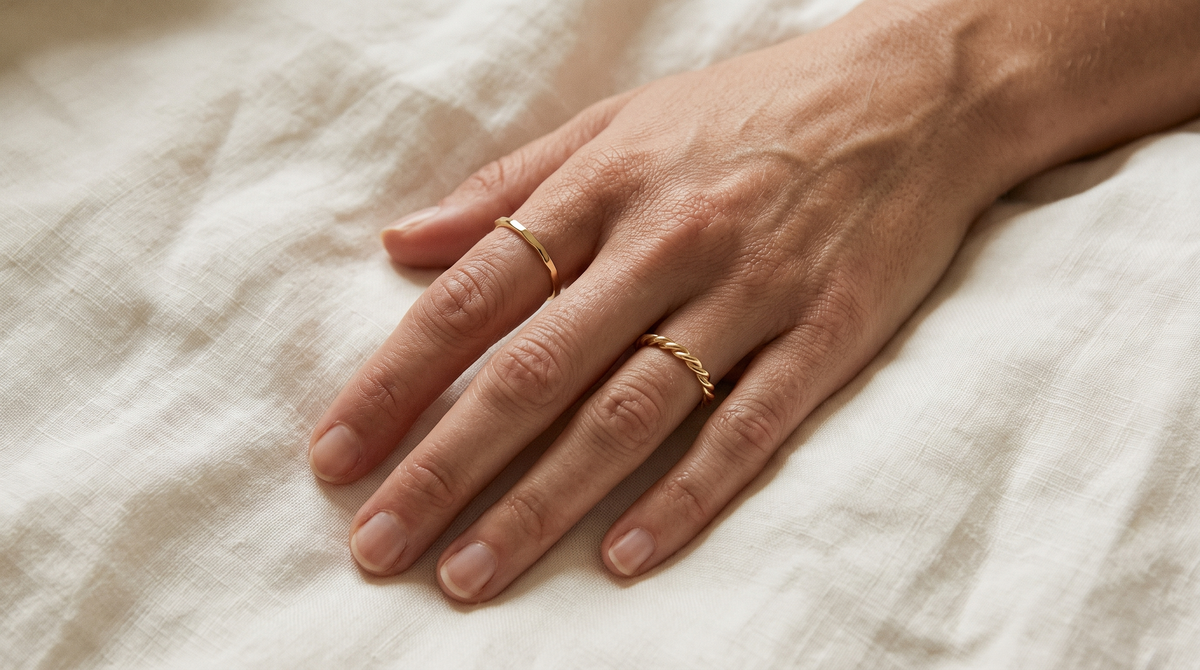
A hand feels busy when every finger is answered. It feels intentional when some are not. Two or three rings spread across a hand, with bare fingers between them, will almost always look more considered than five rings in a row, because the empty fingers are what frame the full ones.
Distribute, do not line up
Skip a finger between rings where you can. A ring on the index finger and another on the ring finger gives each one room to be seen; the bare middle finger in between is not a gap, it is the design. The same applies across hands: the two hands read as one composition, so if one hand carries two rings, the other can carry one, or none.
Mix widths, keep a leader
Rings of identical width blur together. A clearly wider or more textured ring beside a thin quiet band creates hierarchy, and hierarchy is what makes a combination legible. One ring leads, the others agree. If everything on your hand is a statement, nothing is.
Repeating one trait keeps the mix from fragmenting: the same metal, or the same rounded profile, or the same polished finish. Change one variable at a time, not all of them.
Metals and the stopping point
Gold and silver can share a hand. It reads best when each metal appears more than once across both hands, so the odd one out looks invited; the fuller answer is in Can You Mix Gold and Silver Jewelry?.
As for how many: when adding a ring makes you check your hand twice, you have passed the point. Three is usually plenty. Slim bands exist exactly for this game, and the full range of rings is built to combine without shouting. The broader logic is in How to Choose Jewelry That Works Together.